
Simulate the spread of a disease across a landscape
geo_epidemic_simulate.Rdgeo_epidemic_simulate() runs a stochastic, spatially explicit SIR
(susceptible-infected-recovered) model on a grid of host populations,
for example a wildlife disease such as chytridiomycosis in frogs, a
plant pathogen in a forest, or an outbreak among villages. Each cell
holds hosts individuals. In each time step a susceptible host in cell
\(j\) is infected with probability \(1 - e^{-\lambda_j}\),
$$\lambda_j = \beta \left[(1 - m) \frac{I_j}{N_j} + m \sum_i K(d_{ij})
\frac{I_i}{N_i}\right],$$
where \(\beta\) is the transmission rate, \(m\) the share of
contacts made outside the home cell (coupling) and \(K\) the
normalised dispersal kernel of geo_shift_simulate() (exponential or
fat-tailed 2Dt, with optional resistance). Infected hosts recover with
probability \(1 - e^{-\gamma}\) per step, and recovered hosts lose
immunity with probability \(1 - e^{-\omega}\) (omega = 0: lasting
immunity). Time runs in discrete steps, so an infected host stays
infectious for \(1 / (1 - e^{-\gamma})\) steps on average (close to
\(1/\gamma\) when \(\gamma\) is small), and in a single well-mixed
population the basic reproduction number is
\(R_0 = \beta / (1 - e^{-\gamma})\). The expected final share
infected \(z\) then solves \(z = 1 - e^{-R_0 z}\); the tests check
the simulation against this.
Usage
geo_epidemic_simulate(
  hosts,
  initial,
  beta,
  gamma,
  omega = 0,
  coupling = 0.1,
  dispersal_mean,
  times,
  kernel = c("exponential", "2Dt"),
  kernel_shape = 1,
  max_distance = NULL,
  resistance = NULL,
  initial_count = 1,
  nsim = 100,
  seed = NULL,
  threads = 0
)
Arguments
- hosts
SpatRasterof the number of hosts per cell (rounded to whole numbers;NAor 0 = no hosts).- initial
Initially infected hosts: a
SpatRasterof counts, or ansf/SpatVectorof points, each infectinginitial_counthosts in its cell.- beta
Transmission rate per time step.
- gamma
Recovery rate per time step (mean infectious period \(1 / (1 - e^{-\gamma})\) steps).
- omega
Rate of loss of immunity per step (0 = lasting immunity).
- coupling
Share of contacts outside the home cell, 0 to 1.
- dispersal_mean
Mean distance of contacts outside the cell, in metres.
- times
Time steps at which to record the maps (increasing integers).
- kernel
"exponential"or"2Dt"(fat-tailed).- kernel_shape
Shape \(p\) of the 2Dt kernel (above 0.5; smaller is fatter-tailed).
- max_distance
Largest dispersal distance in metres (kernel truncation); default five times the mean for the exponential kernel and ten times for the 2Dt kernel.
- resistance
Optional
SpatRasterof movement resistance (1 = baseline;NA, 0 orInf= barrier).- initial_count
Hosts infected at each starting point.
- nsim
Number of stochastic simulations.
- seed
Random seed.
- threads
Number of threads (0 = OpenMP default).
Value
A list of class tmr_epidemic:
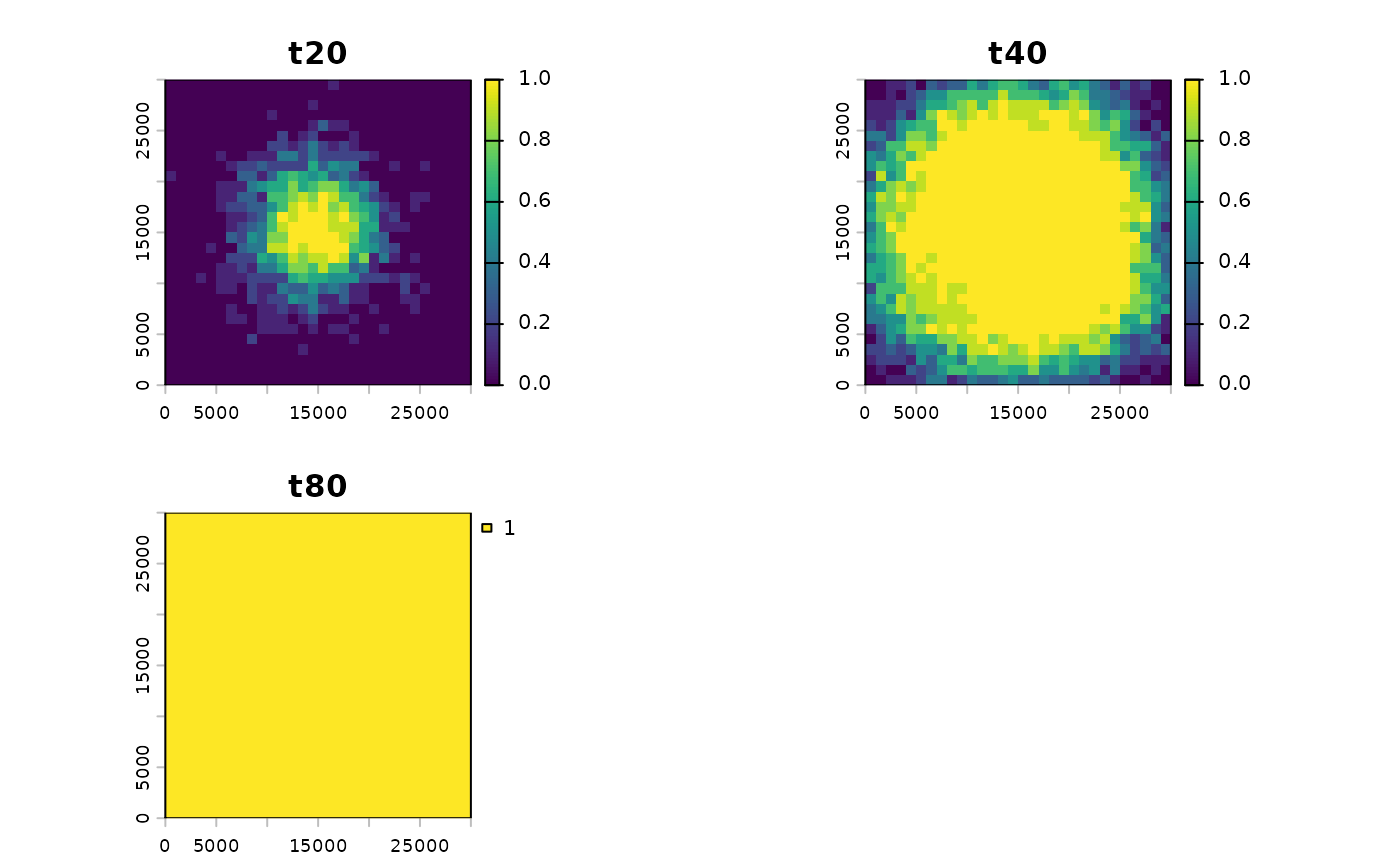
prevalence:SpatRaster, mean share of hosts infected at each oftimes;reached:SpatRaster, probability that the disease has reached each cell by each oftimes;curve: tibble oftimeand mean numberinfectedper step;attack: share of all hosts ever infected, per simulation;settings.
References
Keeling, M. J. and Rohani, P. (2008). Modeling Infectious Diseases in Humans and Animals. Princeton University Press.
Examples
# \donttest{
if (requireNamespace("terra", quietly = TRUE)) {
r <- terra::rast(
nrows = 30, ncols = 30, xmin = 0, xmax = 30000,
ymin = 0, ymax = 30000, crs = "EPSG:32755"
)
hosts <- terra::init(r, 200)
seed <- terra::init(r, 0)
seed[15, 15] <- 5
ep <- geo_epidemic_simulate(hosts, seed,
beta = 0.4, gamma = 0.1, coupling = 0.3,
dispersal_mean = 2000, times = c(20, 40, 80), nsim = 10, seed = 1
)
terra::plot(ep$reached)
mean(ep$attack)
}
 #> [1] 0.9653506
# }